Raki, ouzo, and tsipouro: what's the difference - and why does it matter?
If you've ever sat at a taverna table and been handed a small, cold glass of something clear and anise-scented, you've experienced one of the Mediterranean's great rituals. But what exactly were you drinking? And is it the same thing your neighbour ordered?
The answer is almost certainly no. Raki, ouzo, and tsipouro are three distinct spirits with different origins, different production methods, different legal definitions, and - despite the surface similarity - genuinely different characters in the glass. Understanding the difference matters, whether you're a bartender building a spirits list, a retailer curating a Mediterranean range, or simply someone who wants to order with confidence.
The family tree
All three spirits are part of a broader Mediterranean and Balkan tradition of grape-based distillation - the practice of taking the leftover pomace from winemaking (skins, seeds, stems) and distilling it into something potent and aromatic. This tradition runs from Portugal's bagaceira through Italy's grappa, into Greece, Turkey, and across the Balkans.
Within that family, raki, ouzo, and tsipouro occupy distinct but related positions. Two of them - tsipouro and ouzo - are Greek. One - raki - is Turkish. And the relationship between all three is tangled enough that confusion is entirely understandable.
Tsipouro: the original
Start here, because tsipouro is the oldest and most direct expression of the tradition.
Tsipouro is a pomace spirit - distilled from grape marc, the solid material left after pressing. It is produced across mainland Greece, particularly in Thessaly, Epirus, and Macedonia, as well as on the island of Crete, where it is known as tsikoudia. Production is deeply tied to the agricultural calendar. After the harvest, distillation follows - often in small copper pot stills, often by families who have been doing this for generations.
In its purest form, tsipouro is unaged, clear, and unadulterated - just distilled grape pomace, nothing added. Some versions, however, are made with the addition of anise, which brings it closer in character to ouzo. The distinction matters: anise-free tsipouro is earthy, raw, and bracingly direct. It tastes of the grape, the land, and the still. Anise tsipouro is softer, more aromatic, and more approachable for the uninitiated.
Among the spirits in the Flox portfolio, Patsakis tsipouro from Crete - where it is produced as tsikoudia - represents this tradition in its most elemental form. Single-distilled, unfiltered, made from Cretan grape varieties. It is not a spirit that apologises for itself.
Tsipouro is best served cold, neat, in small glasses, alongside food. The Greek meze tradition exists in part because of spirits like this - the food softens the spirit, the spirit sharpens the appetite for food. It is a relationship, not an afterthought.
Ouzo: Greece's most famous export
Ouzo is tsipouro's more polished sibling - and by far the most internationally recognised of the three.
By Greek and EU law, ouzo must be produced in Greece and must be flavoured with anise. Beyond that, it must meet specific production requirements: a base of neutral grain or grape alcohol, combined with a distillate produced specifically from anise and other botanicals in copper pot stills. The anise character is not optional and not incidental - it is the legal and sensory definition of the category.
The result is a spirit that is more aromatic, more consistent, and more immediately appealing than tsipouro. The anise dominates the nose and palate, but the best ouzo producers balance it with complementary botanicals - fennel, coriander, mastic, cardamom - creating something with genuine complexity behind the headline note.
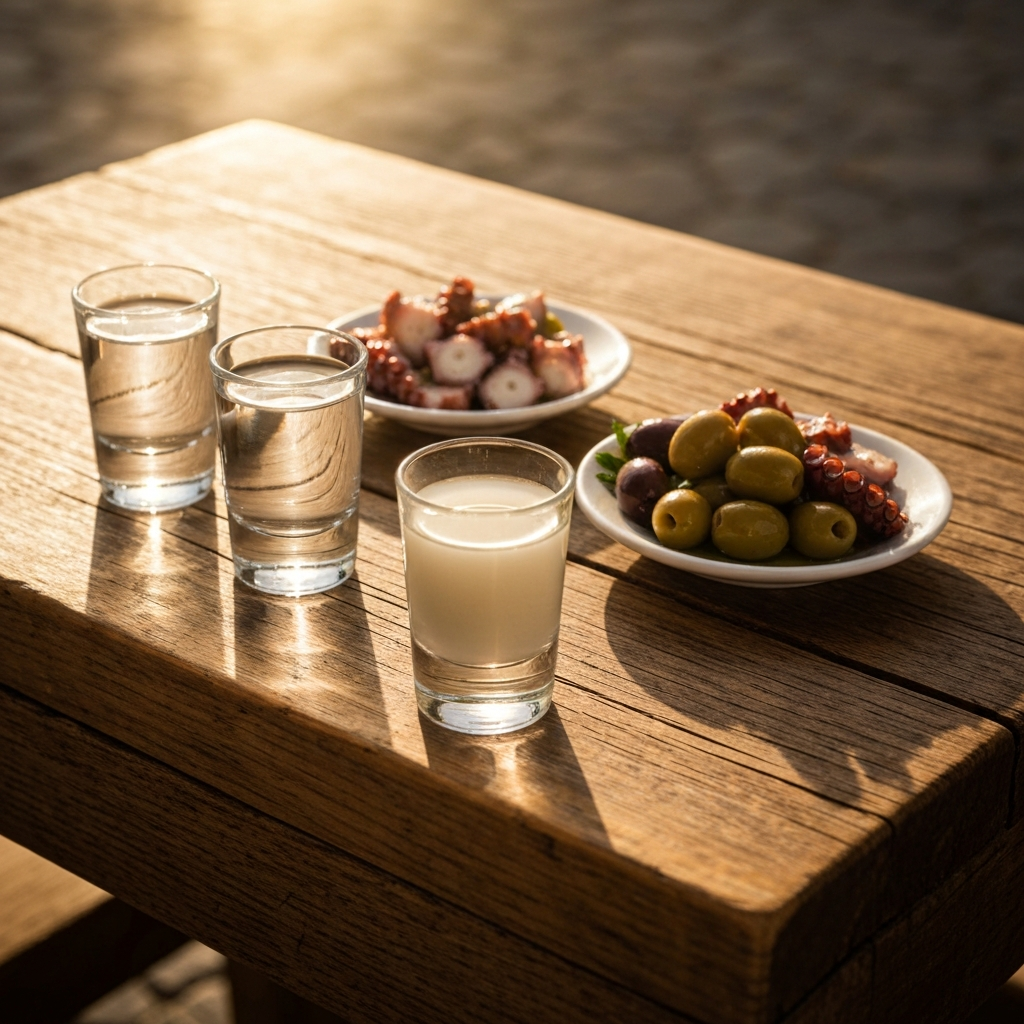
Ouzo's most famous characteristic is louching: when water or ice is added, the spirit turns milky white as the anise oils emulsify. This is not a defect. It is chemistry and theatre simultaneously, and it is part of what makes ouzo one of the world's most visually distinctive spirits.
The canonical way to drink ouzo is with water or ice, alongside mezedes - small plates of food. Grilled octopus. Fried calamari. Taramasalata. Olives. The spirit was designed for this context, and it performs best within it.
For retailers and hospo buyers, ouzo is the entry point to the Greek spirits category. It has name recognition, a clear flavour profile, and genuine cultural cachet. The opportunity lies in trading customers up from the cheap, supermarket-ledger versions to quality producers - where the botanicals are balanced and the distillation is craft rather than industrial.
Raki: Turkey's answer
Here is where it gets interesting, and where the confusion is most persistent.
Turkish raki is not the same as Greek tsipouro, despite being made by a similar method and bearing a similar name. Turkish raki is a grape-based spirit - distilled from grapes and raisins - that is then redistilled with anise. Like ouzo, it louches when water is added. Like ouzo, it is served alongside food. Like ouzo, anise is its defining character.
But raki is distinctly Turkish in identity, in culture, and in flavour. It tends to be higher in alcohol than ouzo (typically 45–50%), with a bolder, more assertive anise character and less of the botanical complexity that distinguishes a well-made ouzo. The Turks call it aslan sütü - lion's milk - and the cultural reverence is genuine. Drinking raki is not casual. It is an occasion.
The serving ritual is specific: raki in a tall glass, a separate glass of cold water alongside, ice on the side. You dilute to taste, traditionally around one part raki to one or two parts water. Food is non-negotiable - raki without a table of meze is considered incomplete.
Mey İçki, within the Flox portfolio, represents the category at serious scale - Turkey's largest spirits producer, now part of Diageo, producing raki that is both the category benchmark and the cultural reference point. For any bar or retailer wanting to serve a Turkish table occasion authentically, this is the starting point.
The comparison in the glass
Putting all three side by side clarifies what prose can only approximate.
Unanised tsipouro is the most raw and agricultural of the three - grapey, fiery, and direct. It rewards those who meet it on its own terms. Anised tsipouro sits between the categories, softer than raki but earthier than ouzo.
Ouzo is the most refined and botanical - the most approachable for a drinker new to the category, and the most versatile in a bar context. It works in cocktails in a way that raki generally does not, and its lower ABV makes it an easier sell for on-premise consumption.
Raki is the boldest of the three. It is a spirit that commands attention rather than inviting it. For the right occasion and the right customer, it is extraordinary. For a casual spirits sale, it requires more explanation than ouzo.
Why it matters for your range
The practical implication for retailers and hospo buyers is straightforward: these are not interchangeable, and they are not all competing for the same customer or occasion.
Ouzo is your entry-level Greek spirits play - accessible, story-rich, and underrepresented on most Australian shelves relative to its quality and cultural depth. Stock one affordable, well-made expression and one premium.
Tsipouro is for the spirits-curious customer who has already found ouzo and wants to go deeper. It is the enthusiast's choice, the one that generates genuine conversation. Position it accordingly.
Raki is for the occasion sell - the Turkish table night, the cultural connection, the customer who already knows what it is and can't find it anywhere. Stock it and you own that customer's loyalty.
Together, they tell a coherent story about Mediterranean spirits culture that no other category can replicate. And that story - authentic, ancient, genuinely distinct - is exactly what independent retailers and thoughtful hospo buyers are looking for right now.
Flox Wines and Spirits imports and distributes raki, ouzo, and tsipouro across Australia.
For trade enquiries, current stock availability, and tasting notes, contact our team.